How Royal BAM Group Uses Enterprise AI to Transform Construction Planning
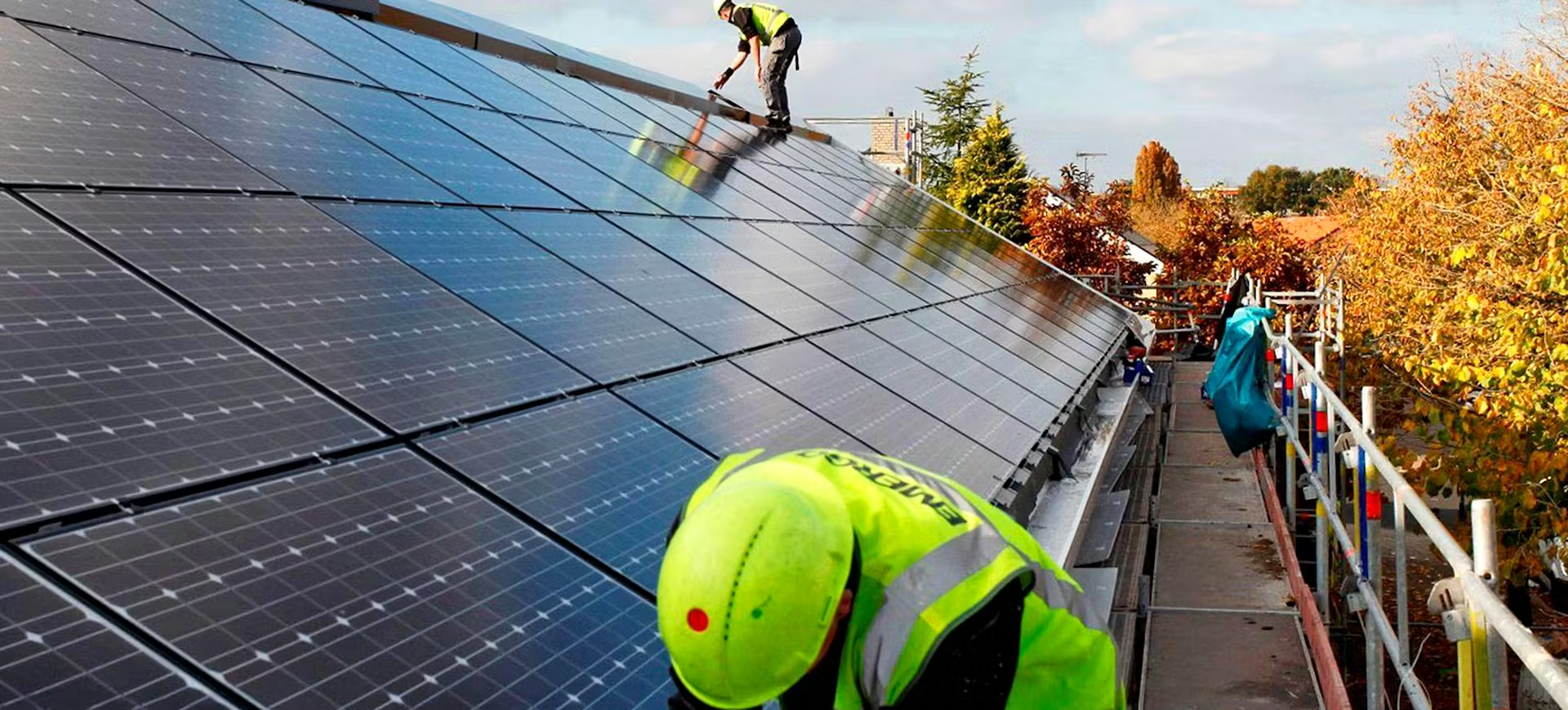
Royal BAM Group, a leading European construction and infrastructure company, set out to modernize core renovation workflows through advanced AI and machine learning. With large volumes of high-quality 3D scan data already available, BAM’s ambition was to operationalize machine learning at scale to improve accuracy, efficiency, and decision-making across renovation projects. A strong data foundation, built on extensive and reliable 3D drone scans, enabled the development of robust and precise machine learning models tailored to real-world construction conditions.
Together with BAM, we initiated a long-term enterprise AI initiative focused on embedding machine learning directly into business-critical construction processes. By designing the solution for deep operational integration from the outset, we ensured alignment with existing workflows and established a single, AI-generated source of truth that supports consistent decision-making across all stakeholders.
3D scanning challenge for construction planning
Renovation projects often suffer from limited or outdated building documentation. At BAM, this challenge was especially evident when working with existing buildings, where original construction drawings were either missing or unreliable.
Although 3D scans of buildings were available, converting these scans into usable construction drawings and measurements remained a manual and time-consuming task, often taking up to a week per building. This delay created uncertainty early in the planning phase, impacting budgeting accuracy, scheduling, and coordination between stakeholders. BAM needed a scalable, AI-driven solution that could transform raw 3D scan data into reliable planning inputs—faster and with higher precision.
Enterprise machine learning solution for automation
The solution was built as an enterprise-grade AI capability, combining our strategic and operational expertise with deep technical execution. Rather than a short-term experiment, the initiative focused on building a robust machine learning pipeline that could be scaled and continuously improved over time.
Key components of the solution included:
- Advanced ML object detection: Custom machine learning models were trained to automatically detect and extract precise dimensions (e.g., window frames) from high-resolution 3D drone scans.
- AI-powered internal tooling: The models were integrated into an internal web application developed together with BAM Wonen’s Renovation Concepts team, enabling seamless use in day-to-day renovation planning.
- Operational alignment: The tooling was designed to fit BAM’s highly regulated construction workflows, ensuring trust, adoption, and long-term usage across teams.
- Continuous learning approach: The solution was developed as a living AI system, allowing models to improve as more data and feedback were added over time.
By embedding machine learning directly into BAM’s renovation workflow, the organization gained earlier access to accurate, standardized measurement data—creating a single source of truth for planning and execution.
Improved project management and workflow automation
The AI Object Detection solution fundamentally changed how BAM plans and executes renovation projects:
- Significantly reduced lead times: The solution has the potential to shorten overall project timelines by up to three weeks.
- Improved accuracy and budgeting: Early access to reliable measurements enables more precise cost estimations and activity planning.
- Better coordination across stakeholders: Clients, contractors, and executors now work from the same verified data set, reducing discrepancies, rework, and misunderstandings.
This enterprise AI initiative demonstrates how advanced machine learning can drive tangible business value in traditionally manual industries. By operationalizing AI at scale, BAM has strengthened its renovation capabilities while laying the foundation for further AI-driven innovation across the organization.
We supported BAM throughout the journey, from strategic framing and ML architecture to implementation and organizational adoption—ensuring that the solution delivers long-term value rather than short-term experimentation.
Key Success Factors
- Enterprise AI mindset: Treating the initiative as a long-term machine learning capability rather than a short pilot.
- Deep ML expertise: Applying advanced object detection models tailored to BAM’s real-world construction data.
- Strong data foundation: Leveraging BAM’s extensive archive of high-quality 3D drone scans.
- Operational integration: Building tooling aligned with real construction workflows to ensure adoption.
- Single source of truth: Establishing shared, AI-generated measurement data across all stakeholders.
Involved Eidra companies
This project was a collaboration between experts from Curamando and Q42.
Read more about Curamando’s AI Automation offerings.