Conversational AI kiosks to streamline transfers for KLM passengers
Rapid prototyping with the Jumpstart methodology
This project highlights our Jumpstart methodology, a fast, cost-effective pressure cooker approach designed to rapidly build and validate working prototypes. In 2024, KLM returned to us, seeking an innovation boost for their critical passenger service kiosks at Schiphol Airport.
AI customer service challenge: Rigid self service kiosk interface
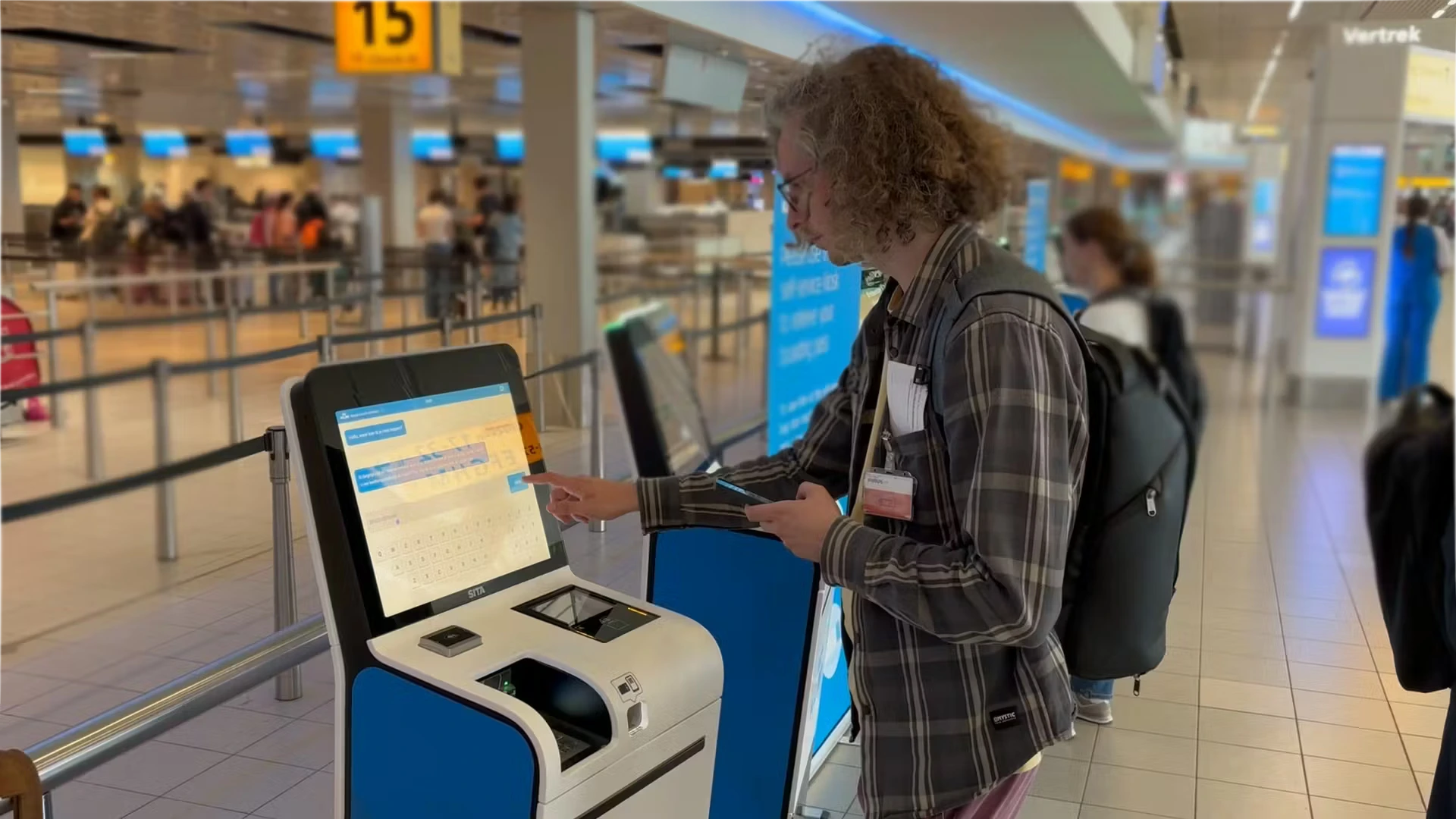
KLM’s interactive self-service kiosks at Schiphol are vital when hundreds of passengers land simultaneously, often needing to rebook missed connecting flights. However, the existing UI was rigid and inflexible. Situations that didn’t fit the standard options, such as two passengers needing rebooking but who couldn’t be booked together via the kiosk, forced passengers to seek assistance from staff. This rigidity created passenger stress and slowed down the resolution process. KLM needed a way to deliver a more human, personal, and efficient interaction at scale to address these friction points.
Conversational AI solution: API integration and UX design
We approached this challenge by challenging the rigid UI with a conversational format, powered by generative AI. The solution was framed as a Jumpstart, a highly focused, one-week project to validate the concept quickly and cost-effectively.
- Collaborative Innovation: The core idea was to replace the rigid UI with a more human-like interface, combining “fuzzy input” (passengers asking random questions) with common presets. This drew inspiration from our own previous AI chat implementations.
- Data-driven safety: We utilized ChatGPT and JavaScript to power the interface. To ensure passenger data security and privacy, we developed a system that avoided sending raw passenger data to OpenAI by hashing it.
- Real-time validation: We gained access to KLM’s APIs, allowing the prototype to work with real flight data. This enabled us to validate two key points: whether the AI could genuinely help passengers effectively, and if the UI was pleasant enough for typing on a large touchscreen.
Improved passenger experience and operational efficiency
The one-week Jumpstart provided immediate and valuable insights, confirming the potential for a scalable, personal service:
- Effective assistance: The prototype demonstrated that the AI-powered chat interface successfully assisted passengers, validating that they did not need further assistance from KLM staff.
- Real-time rebooking: The integration with KLM APIs worked so well that the modified kiosks were able to rebook flights in real-time during testing.
- Accelerated learning: The project reinforced the value of a focused, experimentation mindset. Leny van Eeden, Product Owner Self-Service Kiosk at KLM, noted: “We learned that within one week you can really get more done than you think if you take on the experimentation mindset.”
Our team’s role was to provide the secure technical framework and the rigorous validation process, empowering the KLM team with tangible, proven insights for their next steps.
Key success factors for conversational UI implementation
- The Jumpstart methodology: Using a one-week pressure cooker ensured rapid learning, speed, and cost efficiency.
- Security by design: We used hashing to avoid sending sensitive passenger data to OpenAI, ensuring compliance and passenger trust.
- Real-world data: Access to KLM APIs and real flight data allowed for testing rebooking capabilities in a true operational environment.
- Focus on UX: The validation focused equally on the usability of the chat UI, confirming it worked well even under passenger stress.
Involved Eidra companies:
This project was a collaboration between experts from Curamando and Q42.
Read more about Curamandos offerings within AI Automation and AI Growth Lab.